Air quality sensors & data
The air quality sensors of Breeze Technologies are monitoring all important air quality parameters in real-time. The data quality and accuracy of our sensors has been proven in reference studies.



When you are planning and implementing clean air measures in your city, it is important to have a full picture of the baseline situation and the impact of your clean air interventions. That is why our air quality sensors are equipped with sensing units for all common air pollution indicators by default. Our sensors are capable of measuring:
Additional parameters include:
You did not find the indicator that you are looking for? Together with our partners and customers, we also develop customised sensing solutions on request. Contact us for more information.
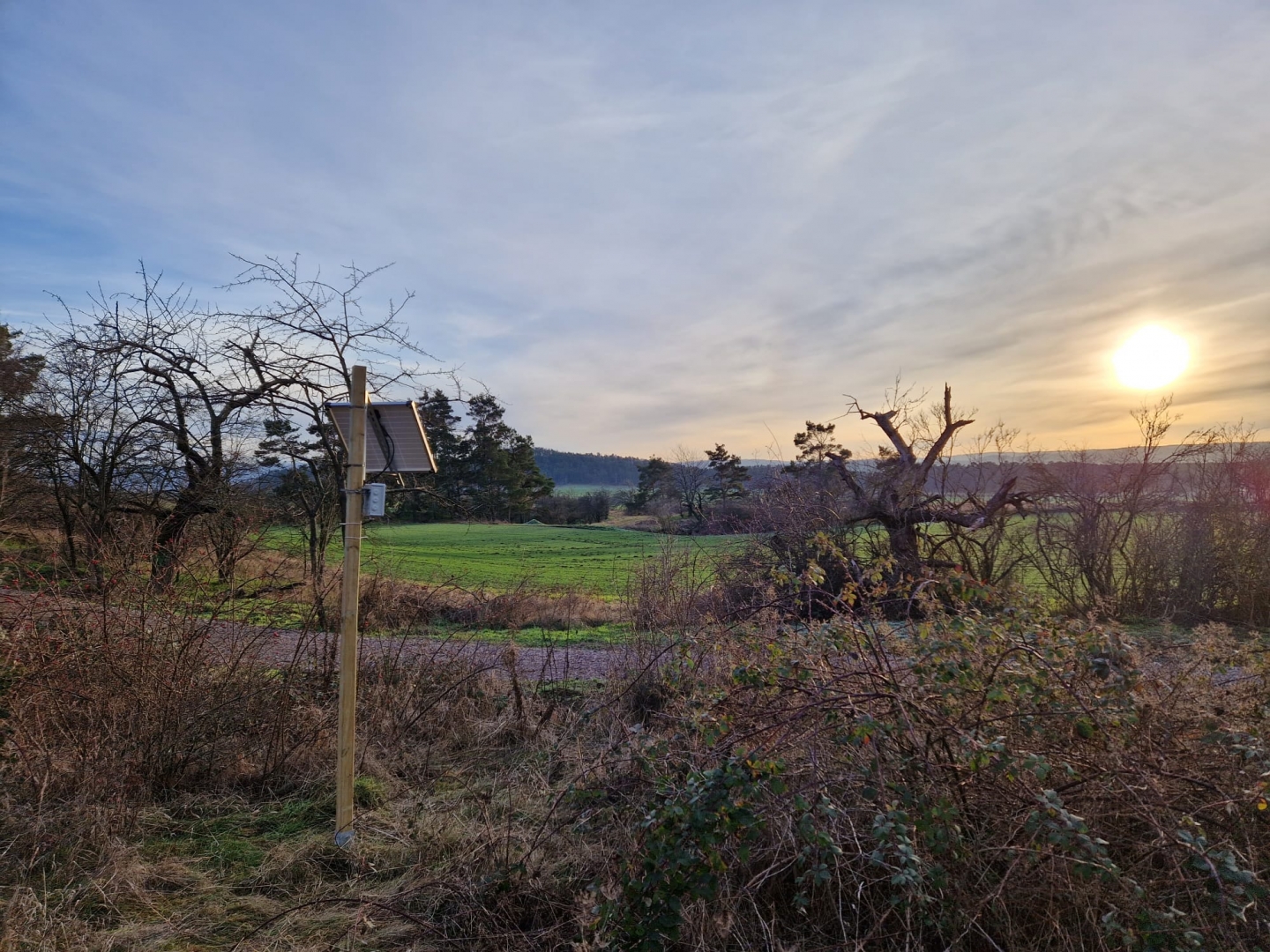
The Breeze air quality sensors and analytics suite enable you to achieve an arbitrarily high data resolution to create a foundation for completely new fields of applications. Our sensors are much smaller than traditional air quality monitoring equipment, averaging just 3.5 inches in diameter. Their form factor allows for easy installation in public spaces, at street lights and on city furniture.
Data is collected in real time, with data points available up to every 30 seconds. Potential problems can be identified as they arise with your city management able to react immediately to solve or mitigate the situation.

The Breeze Environmental Intelligence Cloud is equipped with advanced algorithms for sensor calibration, predictive maintenance and data analytics. Here you have access to real-time and historic air quality data from your sensors, as well as additional insights like comparisons with national and international air quality thresholds.
As an open platform, you can also integrate data from other sensors, or pull out live data from Breeze’s sensors through smart APIs and download functionalities.
EnvironmentalAI provides you with clean air action recommendations from a database of more than 3,500 interventions, to increase the efficiency and effectiveness of clean air actions by 10X.
For analytics needs beyond that, our team of environmental scientists will be happy to work with you on custom analyses.

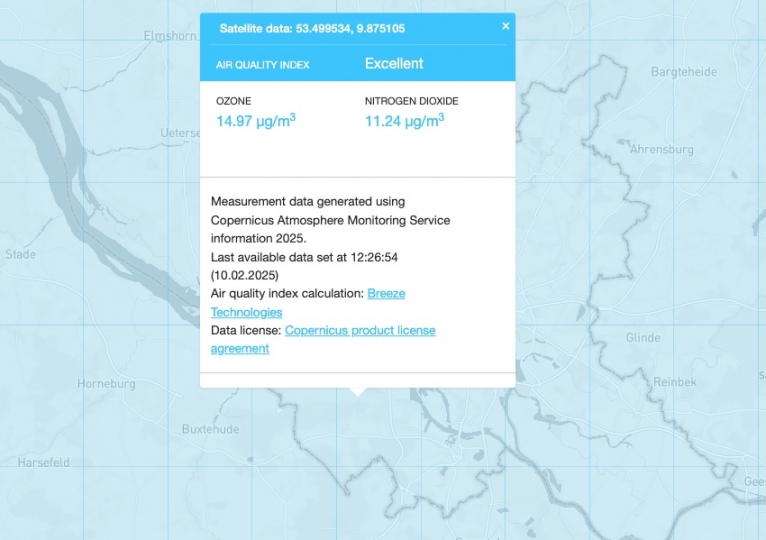
Through the Environmental Intelligence Cloud, we can provide you with access to satellite data from in and around your community. This way, you do not even need to deploy sensors to start acting on your community’s air quality.
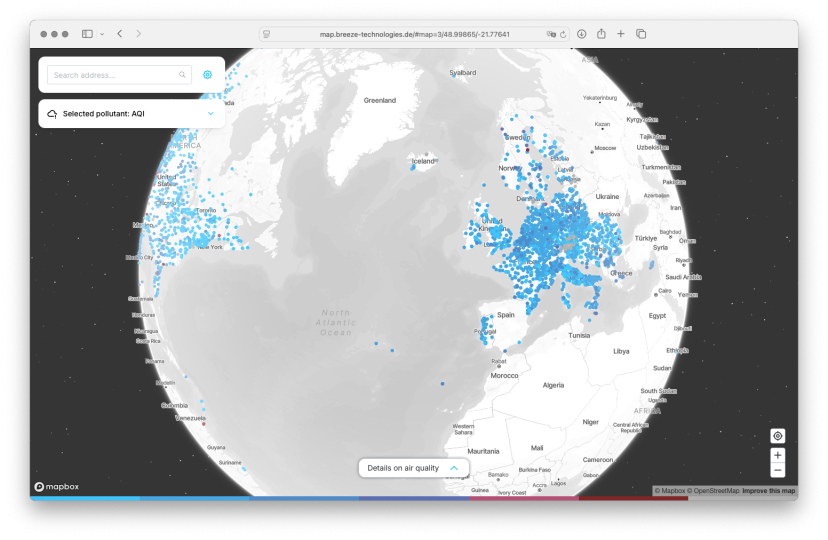
Optionally for every urban sensor deployment, the Breeze Air Quality Citizen Portal delivers citizens hyperlocal air quality data from their neighborhoods. Usual air quality monitoring stations are few and far between, lacking the necessary relevance for citizens. Our portal provides hyperlocal data, directly engaging citizens in caring about local air quality and their own role in improving it.
Find out more about the air quality in the places that matter most to you with the Breeze Air Quality Citizen Portal.

Developed by Breeze Technologies for the European Comission, the AQWidget is open source software that enables you to integrate real-time air quality information into any website.
Environmental data is easily integrable in municipal management processes and helps to create more livable environments. In the future you will not only be able to recognize problems like traffic jams to initiate appropriate countermeasures. You can also analyze the impact urban development activities have on the urban climate, identify best practices and optimize your city layout. The possibilities are almost endless.
Integrate environmental data in urban planning processes to identify potential for optimisation, successes and local best practices
Air pollution dispersion can be geo-spatially analysed – even identifying individual polluters is sometimes possible
Citizen science initiatives activate citizens for climate protection activities – have citizens act as sensor hosts or participate in hackathons
Routing and traffic shaping based on air quality data to reduce overall pollution exposure in the cityscape, integration in public transport services
Showcase particularly good air quality to increase attractiveness in tourism and family settlement, as well as a tourism destination
Integrate air quality data in a horizontal smart city platform to create synergies with other urban data sources
The pioneering startup has been established in 2015 thanks to a European-funded innovation and accelerator programme for smart cities. It has been named one of the EU’s most promising start-ups by the European Parliament. Breeze Technologies’ founder Robert Heinecke is part of the European Forbes 30 Under 30.


Breeze Technologies was founded as part of SpeedUP! Europe, one of the 16 FIWARE accelerators, and has been honored as a FIWARE success story. FIWARE is a European project which aims to provide the core platform of the Future Internet.